

Cloud Balancing — the Classic Bin-Packing Problem in LangGOAP#
A Tier 2 tutorial that translates the classic cloud-balancing bin-packing problem into a LangGOAP A* + CSP pipeline.
The problem#
Given a pool of computers and a set of processes, assign every process to exactly one computer such that:
No computer exceeds its CPU, memory, or network capacity — hard per-resource constraints enforced by the CSP phase.
The total USD cost is minimised as an objective: the pipeline compares the A* plan against alternative assignments and runs the cheapest feasible one.
The dataset below is a 4-process subset of a standard
2computers-6processes.json fixture, with per-process cost_usd
values derived by dividing the original server costs
by 10 (see the data module’s docstring for full provenance).
LangGOAP modelling#
GOAP concept |
Cloud balancing interpretation |
|---|---|
|
|
precondition |
|
effect |
|
|
per-server cpu/mem/net + |
goal |
every process assigned |
goal |
per-server capacity caps |
goal |
minimize |
Pipeline behaviour#
A* searches the plan space quickly — any assignment that flips every
assigned_* flag to True is a valid A* solution, and with one unit of
cost per assignment they all tie. The CSP phase then:
Validates capacity. Resource totals are computed per server and checked against the hard constraints.
Compares alternatives. Because the goal states a preference (
minimize cost_usd), the pipeline enumerates alternative plans breadth-first — excluding one action of the A* plan, then two — up tomax_alternatives(8 by default), validates each, and asks CP-SAT for the cheapest feasible candidate. Objectives change which plan runs, not only how it is scored.Reports status; infeasible plans do not run by default. The status and resource breakdown are attached to
plan.metadata.csp. When no candidate is feasible,GoapGraphends the run withno_planand an explanation;GoalPolicy(on_infeasible="execute")runs the plan anyway.
import logging

# Suppress the advisory warning the CSP pipeline emits when primary and
# alternative plans are all infeasible — we demonstrate that case
# deliberately later in this notebook.
logging.getLogger("langgoap").setLevel(logging.ERROR)

from tutorial_examples.cloud_balancing import (
    cloud_balancing_actions,
    cloud_balancing_goal,
    cloud_balancing_start,
)
from tutorial_examples.data.cloud_balancing_instance import PROCESSES, SERVERS

from langgoap import CSPStatus, GoapGraph
from langgoap.planner.pipeline import plan as pipeline_plan

print("Servers:")
for s in SERVERS:
    print(f"  {s.name:14s} cpu={s.cpu:2d} mem={s.memory:2d} net={s.network:2d} cost/proc=${s.cost_usd_per_proc:6.0f}")
print("\nProcesses:")
for p in PROCESSES:
    print(f"  {p.name:4s} cpu={p.cpu} mem={p.memory} net={p.network}")
Servers:
  server_big     cpu=24 mem=96 net=16 cost/proc=$   480
  server_small   cpu= 6 mem= 4 net= 6 cost/proc=$    66

Processes:
  p0   cpu=1 mem=1 net=1
  p1   cpu=3 mem=6 net=1
  p2   cpu=1 mem=1 net=3
  p5   cpu=1 mem=1 net=5
1. Action catalog#
Every (process, computer) pair becomes a distinct ActionSpec.
With 4 processes and 2 servers, the planner sees 8 actions — each
consuming resources on its target server.
actions = cloud_balancing_actions()
print(f"Total actions: {len(actions)}")
for a in actions[:4]:
    print(f"  {a.name:34s} resources={dict(a.resources)}")
Total actions: 8
  assign_p0_to_server_big            resources={'cpu_server_big': 1.0, 'mem_server_big': 1.0, 'net_server_big': 1.0, 'cost_usd': 480.0}
  assign_p0_to_server_small          resources={'cpu_server_small': 1.0, 'mem_server_small': 1.0, 'net_server_small': 1.0, 'cost_usd': 66.0}
  assign_p1_to_server_big            resources={'cpu_server_big': 3.0, 'mem_server_big': 6.0, 'net_server_big': 1.0, 'cost_usd': 480.0}
  assign_p1_to_server_small          resources={'cpu_server_small': 3.0, 'mem_server_small': 6.0, 'net_server_small': 1.0, 'cost_usd': 66.0}
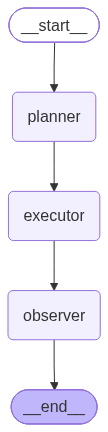
GOAP Execution Graph#
The planner discovers a plan, the executor runs each action, and the observer checks progress — replanning automatically if something fails.
from IPython.display import Image, display

graph = GoapGraph(actions=actions)
display(Image(graph.compile().get_graph().draw_mermaid_png()))
2. Run the A* → CSP pipeline#
langgoap.planner.pipeline.plan() runs A* first, then routes the
result through the CSP validator. The returned Plan carries
metadata.csp with status, resource usage breakdown, and
constraint evaluations.
plan_obj = pipeline_plan(
    cloud_balancing_start(),
    cloud_balancing_goal(),
    actions,
)

print(f"CSP status: {plan_obj.metadata.csp.status.value}")
print(f"Plan:")
for step in plan_obj.actions:
    print(f"  {step.name}")
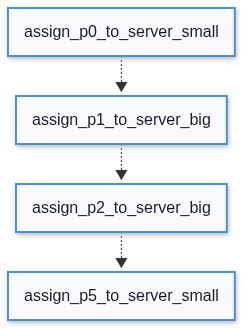
CSP status: optimal
Plan:
  assign_p0_to_server_small
  assign_p1_to_server_big
  assign_p2_to_server_big
  assign_p5_to_server_small
display(Image(plan_obj.draw_mermaid_png()))
3. Resource usage breakdown#
CSPMetadata.resource_usage reports the aggregate total for every
resource key touched by the plan. p1 needs server_big (its 6
memory units exceed server_small’s 4), and server_small’s network
capacity of 6 admits two of the three remaining processes, so the
cheapest feasible placement costs 480 * 2 + 66 * 2 = 1092. The A*
plan alone put everything on server_big ($1920); the objective
found the $1092 placement among the enumerated alternatives.
usage = {u.key: u.total for u in plan_obj.metadata.csp.resource_usage}

print("Per-server utilization (usage / capacity):")
for s in SERVERS:
    cpu = usage.get(f'cpu_{s.name}', 0)
    mem = usage.get(f'mem_{s.name}', 0)
    net = usage.get(f'net_{s.name}', 0)
    print(f"  {s.name:14s} cpu={cpu:3.0f}/{s.cpu:<3d} mem={mem:3.0f}/{s.memory:<3d} net={net:3.0f}/{s.network:<3d}")

print(f"\nTotal cost: ${usage.get('cost_usd', 0):.2f}")
Per-server utilization (usage / capacity):
  server_big     cpu=  4/24  mem=  7/96  net=  4/16
  server_small   cpu=  2/6   mem=  2/4   net=  6/6

Total cost: $1092.00
4. Forced placement via hard constraints#
Process p1 requires 6 memory units — more than server_small
provides (4). Any plan that places p1 on server_small would
violate the mem_server_small ≤ 4 constraint. The CSP validator
will reject such a plan, and the pipeline will enumerate
alternatives to find a legal assignment for p1.
Let’s force the issue: start with every process except p1
pre-assigned to server_small so A* only has to place p1.
start = cloud_balancing_start()
# Pretend p0, p2, p5 are already running on server_small — valid because
# their combined cpu=3, mem=3, net=9 (note: net=9 would overflow server_small's
# net=6, but we won't re-validate the starting state here — we're only
# demonstrating that the planner picks server_big for p1 in isolation).
start_p1_only = dict(start)
start_p1_only["assigned_p0"] = True
start_p1_only["assigned_p2"] = True
start_p1_only["assigned_p5"] = True

plan_p1 = pipeline_plan(
    start_p1_only,
    cloud_balancing_goal(),
    actions,
)

assert plan_p1 is not None
p1_step = next(a for a in plan_p1.actions if "_p1_" in a.name)
print(f"p1 was placed on: {p1_step.name.rsplit('_to_', 1)[1]}")
print(f"(server_small mem=4 < p1.mem=6 → the only feasible computer is server_big)")
p1 was placed on: server_big
(server_small mem=4 < p1.mem=6 → the only feasible computer is server_big)
5. Infeasibility: a cost budget that can’t be met#
The cheapest feasible assignment costs $1092 (three processes on
server_small would exceed its network capacity). Adding a hard
cost_usd ≤ 100 constraint therefore makes every candidate plan
infeasible.
pipeline_plan still returns the primary plan, stamped infeasible
on plan.metadata.csp, so the caller can inspect it. A GoapGraph
run ends with no_plan instead of executing such a plan unless
GoalPolicy(on_infeasible="execute") is set.
from langgoap import ConstraintSpec, GoalSpec
from langgoap.goals import ObjectiveDirection

tight_goal = GoalSpec(
    conditions={f"assigned_{p.name}": True for p in PROCESSES},
    constraints=(
        ConstraintSpec(key="cost_usd", max=100.0, level="hard"),
    ),
    objectives={"cost_usd": ObjectiveDirection.MINIMIZE},
)

tight_plan = pipeline_plan(
    cloud_balancing_start(),
    tight_goal,
    actions,
)

cost_usd = next(u.total for u in tight_plan.metadata.csp.resource_usage if u.key == 'cost_usd')
print(f"Budget:       $100.00")
print(f"Plan cost:    ${cost_usd:.2f}")
print(f"CSP status:   {tight_plan.metadata.csp.status.value}")
Budget:       $100.00
Plan cost:    $1920.00
CSP status:   infeasible
6. End-to-end via GoapGraph#
For production deployments, you’d wire this up via GoapGraph
and let LangGraph run the full plan → execute → observe loop.
The executor applies the effects of each assignment in order,
and the observer checks the goal conditions after every step.
result = GoapGraph(actions=actions).invoke(
    goal=cloud_balancing_goal(),
    world_state=cloud_balancing_start(),
)

print(f"Status:   {result['status']}")
assigned = sorted(k for k, v in result['world_state'].items() if v is True)
print(f"Assigned: {assigned}")
Status:   goal_achieved
Assigned: ['assigned_p0', 'assigned_p1', 'assigned_p2', 'assigned_p5']
Summary#
One problem instance, one LangGOAP action catalog. Each
(process, computer)pair is a distinctActionSpec; resources and constraints handle the bin-packing rules.A proposes, CSP disposes.* A* finds a plan fast; CSP validates capacity and, because the goal minimises cost, compares the plan against alternatives enumerated breadth-first and runs the cheapest feasible one.
Forced placements come for free. Hard constraints catch illegal assignments (like
p1onserver_small) without custom logic.Infeasible plans are reported, not executed.
GoapGraphends the run withno_planand an explanation;plan.metadata.cspcarries the status and resource breakdown, andGoalPolicy(on_infeasible="execute")opts into running anyway.
Every scenario here is verified by
tests/integration/test_cloud_balancing.py.