

Flexible Job Shop — the complete pipeline in one notebook#
This is the final Tier 3 tutorial and deliberately exercises every major subsystem against a single deterministic instance. Nothing in this notebook is approximate — every number is pinned in tests/integration/test_flexible_job_shop.py and regenerated top-to-bottom on every run.
The classic Flexible Job Shop Scheduling Problem (FJSSP) lets each operation run on one of several eligible machines with different processing times. LangGOAP’s CP-SAT scheduler does not model per-machine mutex natively (there is no NoOverlap resource), so the FJSSP “choose a machine” decision is recast here as a “choose a mode” decision on each operation: express runs on an in-house fast machine that is pricey per hour; standard runs on a cloud worker that is cheap but slow. This is the same recasting that project_job_scheduling.ipynb uses for MRCPSP, and it is the idiomatic LangGOAP pattern for flexibility problems.
What you will see working together:
A* finds the greedy-by-cost plan (all
*_expressmodes), and acost_usd → MINIMIZEobjective alone is enough for the pipeline to trade it for a cheaper alternative.CSP validation rejects the greedy plan under a
cost_usd=130hard cap, triggering the pipeline’s enumeration path.CSP enumeration + multi-plan optimization picks the cheapest single-blacklist alternative via CP-SAT Boolean selection variables with a
cost_usd → MINIMIZEobjective.CSP temporal scheduling places three independent jobs on parallel tracks with per-job precedence chains, giving a makespan dominated by the critical-path job (
gamma).Hard / soft / infeasible score decomposition across three goal variants (no cap, impossible cap, soft cap).
Fluent
ConstraintBuilderreproduces the hand-rolled goal structurally — theConstraintProvideranalogue.GoapGraphtracer +StoreExecutionHistorycapture the planning telemetry and persist anExecutionRecordin a LangGraphInMemoryStore.plan.draw_gantt_png()renders the resulting schedule as a Gantt chart PNG fromCSPMetadata.schedule.
1. The flexible job shop domain#
The instance is deliberately small: 3 jobs (alpha, beta, gamma), each with 2 sequential operations (prepare → finalize), each with 2 modes (express, standard). That gives 3 × 2 × 2 = 12 actions total — a tiny catalog the CSP solver dispatches in milliseconds and every number in this notebook can be checked by hand.
Every action aggregates two resources: cost_usd (the CSP constraint and objective) and duration_hours (informational). Every action also carries a datetime.timedelta duration that feeds CP-SAT’s temporal scheduler.
from tutorial_examples.data.flexible_job_shop_instance import (
    ALT_PLAN_COST,
    ALT_PLAN_COST_USD,
    ALT_PLAN_MAKESPAN_HOURS,
    ALT_PLAN_DURATION_HOURS,
    GREEDY_COST_USD,
    GREEDY_DURATION_HOURS,
    GREEDY_MAKESPAN_HOURS,
    HARD_COST_CAP,
    JOBS,
    SOFT_CAP,
)
from tutorial_examples.flexible_job_shop import (
    flexible_job_shop_actions,
    flexible_job_shop_goal,
    flexible_job_shop_goal_fluent,
    flexible_job_shop_start,
)

actions = flexible_job_shop_actions()
start = flexible_job_shop_start()

print(f"jobs            : {[j.name for j in JOBS]}")
print(f"total actions   : {len(actions)}")
print(f"state flags     : {len(start)}")
print()
print(f"{'action':<26}{'dur':<6}{'cost_usd':<10}preconditions")
print("-" * 86)
for a in actions:
    dur = f"{int(a.duration.total_seconds() / 3600)}h" if a.duration else "-"
    cost_usd = a.resources["cost_usd"]
    pre = ", ".join(f"{k}={v}" for k, v in a.preconditions.items()) or "(none)"
    print(f"{a.name:<26}{dur:<6}{cost_usd:<10}{pre}")
jobs            : ['alpha', 'beta', 'gamma']
total actions   : 12
state flags     : 6

action                    dur   cost_usd  preconditions
--------------------------------------------------------------------------------------
prepare_alpha_express     2h    20.0      prepare_alpha_done=False
prepare_alpha_standard    4h    8.0       prepare_alpha_done=False
finalize_alpha_express    1h    10.0      finalize_alpha_done=False, prepare_alpha_done=True
finalize_alpha_standard   2h    4.0       finalize_alpha_done=False, prepare_alpha_done=True
prepare_beta_express      3h    30.0      prepare_beta_done=False
prepare_beta_standard     5h    12.0      prepare_beta_done=False
finalize_beta_express     2h    20.0      finalize_beta_done=False, prepare_beta_done=True
finalize_beta_standard    3h    8.0       finalize_beta_done=False, prepare_beta_done=True
prepare_gamma_express     4h    40.0      prepare_gamma_done=False
prepare_gamma_standard    6h    15.0      prepare_gamma_done=False
finalize_gamma_express    3h    30.0      finalize_gamma_done=False, prepare_gamma_done=True
finalize_gamma_standard   4h    10.0      finalize_gamma_done=False, prepare_gamma_done=True
GOAP Execution Graph#
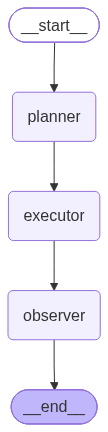
The planner discovers a plan, the executor runs each action, and the observer checks progress — replanning automatically if something fails.
from IPython.display import Image, display

from langgoap import GoapGraph

graph = GoapGraph(actions=actions)
display(Image(graph.compile().get_graph().draw_mermaid_png()))
Two design choices make this a clean showcase:
prepare_*actions have no prior-op guards — the three jobs are mutually independent, so the scheduler is free to run them in parallel.finalize_*_*requires the matchingprepare_*_done— this encodes the per-job precedence chain as a plain precondition. The scheduler picks this up automatically via effect→precondition matching inplanner/csp.py::build_dependency_graph.
2. Greedy plan via the A* → CSP pipeline#
The A* heuristic minimizes the sum of Mode.cost (wall-clock hours), so the construction plan picks every *_express mode. To look at that plan on its own we give the goal a hard-only shape: no objective and a generous cost_usd cap that nothing can violate. A goal that states only hard limits is satisfied by the first feasible A* plan, and the cap is what routes it through CP-SAT so plan.metadata.csp carries the schedule. (Section 3b shows what the cost_usd → MINIMIZE objective does to this plan.)
from langgoap import pipeline_plan

GENEROUS_CAP = 10_000.0  # a hard limit nothing can violate

greedy = pipeline_plan(
    start,
    flexible_job_shop_goal(
        minimize_cost_usd=False, max_cost_usd=GENEROUS_CAP, max_cost_level="hard"
    ),
    actions,
)
assert greedy is not None

print(f"action_names : {greedy.action_names}")
print(f"total_cost   : {greedy.total_cost}")
print(f"score        : {greedy.score}")
action_names : ['prepare_alpha_express', 'finalize_alpha_express', 'prepare_beta_express', 'finalize_beta_express', 'prepare_gamma_express', 'finalize_gamma_express']
total_cost   : 15.0
score        : HardSoftScore(hard=0, soft=0)
display(Image(greedy.draw_mermaid_png()))
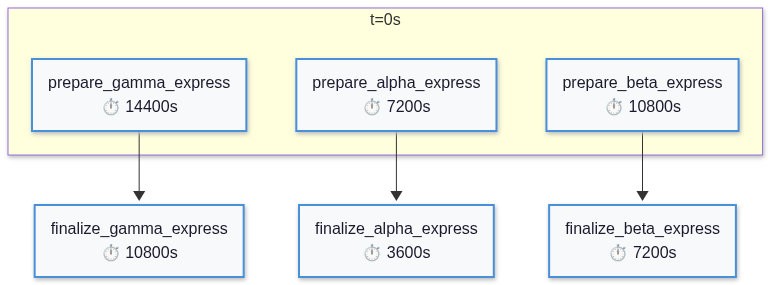
Six actions, one per operation per job, all in *_express mode. The A* total cost is 15.0 (2+1+3+2+4+3), and the HardSoftScore is hard=0.0, soft=0.0 — the plan is feasible and, because the goal states no preference, there is nothing to score softly. The aggregate cost_usd = 150 shows up in resource_usage below.
3. Schedule — three jobs in parallel, gamma on the critical path#
CP-SAT’s temporal scheduler turns every ActionSpec.duration into an IntervalVar and seeds precedence edges from the dependency graph. Because the three jobs share no preconditions, all three prepare_*_express actions start at t=0 and run in parallel. Each job’s finalize_* waits only for its own prepare, so the makespan is the maximum per-job duration:
Job |
Prepare (express) |
Finalize (express) |
Per-job duration |
|---|---|---|---|
alpha |
2h |
1h |
3h |
beta |
3h |
2h |
5h |
gamma |
4h |
3h |
7h ← critical path |
Serial execution would take 15h; parallelism collapses the wall-clock time to 7h.
from datetime import timedelta

csp = greedy.metadata.csp
assert csp is not None

print(f"status   : {csp.status.value}")
print(f"makespan : {csp.makespan}")
print()
print(f"{'action':<26}{'start':>10}{'end':>10}")
print("-" * 46)
for entry in sorted(csp.schedule, key=lambda s: (s.start, s.action_name)):
    print(f"{entry.action_name:<26}{str(entry.start):>10}{str(entry.end):>10}")

assert csp.makespan == timedelta(hours=GREEDY_MAKESPAN_HOURS)
status   : feasible
makespan : 7:00:00

action                         start       end
----------------------------------------------
prepare_alpha_express        0:00:00   2:00:00
prepare_beta_express         0:00:00   3:00:00
prepare_gamma_express        0:00:00   4:00:00
finalize_gamma_express       4:00:00   7:00:00
finalize_beta_express        5:00:00   7:00:00
finalize_alpha_express       6:00:00   7:00:00
Gantt chart#
plan.draw_gantt_png() renders the schedule from CSPMetadata.schedule as a PNG image. The three overlapping prepare_*_express bars at the top and the shifted finalize_*_express tails tell the whole parallelism story in one picture.
display(Image(greedy.draw_gantt_png()))

3b. Objectives select plans#
Now put the cost_usd → MINIMIZE objective back and drop the cap. An objective is a preference, and a preference makes the pipeline compare the A* plan against alternative plans and let CP-SAT pick the best one, with total cost as the tie-breaker. Alternatives are enumerated breadth-first over excluded actions: every plan one swap away from the A* plan, then two swaps away, until max_alternatives (8 by default) candidates have been found.
The all-express plan costs cost_usd = 150. Within two swaps the cheapest candidate takes the standard mode for the alpha and beta prepares ($20 → $8 and $30 → $12) and keeps everything else express: cost_usd = 120, four extra duration hours, and the same 7-hour makespan because neither stretched chain passes gamma’s. That plan wins — before 0.2.0 a feasible A* plan was returned unchanged and the objective never influenced which plan ran.
minimized = pipeline_plan(start, flexible_job_shop_goal(), actions)
assert minimized is not None and minimized.metadata.csp is not None

print(f"action_names    : {minimized.action_names}")
print(f"total_cost      : {minimized.total_cost}")
print(f"score           : {minimized.score}")
print(f"plans_evaluated : {minimized.metadata.csp.plans_evaluated}")
print(f"makespan        : {minimized.metadata.csp.makespan}")

assert {"prepare_alpha_standard", "prepare_beta_standard"} <= set(minimized.action_names)
assert minimized.total_cost == ALT_PLAN_COST
assert minimized.score.soft == -ALT_PLAN_COST_USD
assert minimized.metadata.csp.plans_evaluated > 1
assert minimized.metadata.csp.makespan == timedelta(hours=ALT_PLAN_MAKESPAN_HOURS)
action_names    : ['prepare_alpha_standard', 'finalize_alpha_express', 'prepare_beta_standard', 'finalize_beta_express', 'prepare_gamma_express', 'finalize_gamma_express']
total_cost      : 17.0
score           : HardSoftScore(hard=0, soft=-120)
plans_evaluated : 9
makespan        : 7:00:00
Selection is a bounded refinement#
Alternative enumeration compares the A* plan with its neighbourhood; it is not a global optimiser. The cheapest plan of all 64 mode combinations is every mode standard — cost_usd = 57 for a 10-hour makespan — but it lies six swaps away from the greedy plan, beyond the default budget. Two ways to reach it:
widen
max_alternativesso the breadth-first search enumerates every combination, orwhen an objective should dominate, make it the A* cost itself: A* then minimises it directly and no enumeration is needed.
from dataclasses import replace

exhaustive = pipeline_plan(start, flexible_job_shop_goal(), actions, max_alternatives=63)
assert exhaustive is not None and exhaustive.metadata.csp is not None
print(f"max_alternatives=63 : cost_usd={-exhaustive.score.soft:.0f}  makespan={exhaustive.metadata.csp.makespan}  plans_evaluated={exhaustive.metadata.csp.plans_evaluated}")

usd_actions = [replace(a, cost=float(a.resources["cost_usd"])) for a in actions]
direct = pipeline_plan(start, flexible_job_shop_goal(), usd_actions)
assert direct is not None and direct.metadata.csp is not None
print(f"cost = cost_usd A*  : cost_usd={direct.total_cost:.0f}  makespan={direct.metadata.csp.makespan}  plans_evaluated={direct.metadata.csp.plans_evaluated}")

assert -exhaustive.score.soft == direct.total_cost == 57.0
assert all(n.endswith("_standard") for n in direct.action_names)
max_alternatives=63 : cost_usd=57  makespan=10:00:00  plans_evaluated=64
cost = cost_usd A*  : cost_usd=57  makespan=10:00:00  plans_evaluated=9
4. CSP enumeration under a hard cost_usd cap#
Now attach a hard cost cap. The greedy plan aggregates cost_usd = 150, so a cost_usd <= 130 hard constraint rejects it. validate_plan() marks the primary plan INFEASIBLE; the pipeline then calls enumerate_alternatives(), which excludes actions of the rejected plan breadth-first (one swap, then two) and re-runs A* for each exclusion set. Every surviving alternative feeds optimize_plans(), which builds a single CP-SAT model with Boolean selection variables, applies the hard constraint, and minimizes the weighted objective.
Among the candidates within the default budget, the one that satisfies cost_usd <= 130 and minimizes cost_usd is the same two-standard-prepares plan as above: cost_usd falls from 150 → 120 for four extra duration hours and no extra makespan.
capped_goal = flexible_job_shop_goal(
    max_cost_usd=HARD_COST_CAP, max_cost_level="hard"
)
capped = pipeline_plan(
    start, capped_goal, actions
)
assert capped is not None
capped_csp = capped.metadata.csp
assert capped_csp is not None

print(f"action_names : {capped.action_names}")
print(f"status       : {capped_csp.status.value}")
print(f"total_cost   : {capped.total_cost}")
print(f"score        : {capped.score}")
print()
print("resource_usage:")
for usage in capped_csp.resource_usage:
    print(
        f"  {usage.key:<16} total={usage.total:<7}"
        f" level={usage.level:<4} satisfied={usage.satisfied}"
    )

assert {"prepare_alpha_standard", "prepare_beta_standard"} <= set(capped.action_names)
assert "prepare_alpha_express" not in capped.action_names
action_names : ['prepare_alpha_standard', 'finalize_alpha_express', 'prepare_beta_standard', 'finalize_beta_express', 'prepare_gamma_express', 'finalize_gamma_express']
status       : optimal
total_cost   : 17.0
score        : HardSoftScore(hard=0, soft=-120)

resource_usage:
  cost_usd         total=120.0   level=hard satisfied=True
  duration_hours   total=19.0    level=info satisfied=True
A few things to notice:
status = optimal— multi-plan CP-SAT returnsOPTIMALwhen it has proved it found the minimum (it has), not just a feasible selection.makespanis populated —optimize_plans()only picks the best plan, so the pipeline re-validates the selected plan withvalidate_plan()to attach itsIntervalVarschedule and makespan (still 7h here: the standard alpha and beta prepares finish inside gamma’s chain).cost_usd.level = 'hard'— the usage entry is stamped with the level of its matchingConstraintSpec. Since we declaredcost_usdhard, it readshard(notinfo).duration_hours.level = 'info'— no constraint was declared onduration_hours, so it staysinfo. A visualizer can render the two differently.soft = -120— the MINIMIZE objective sums to120, and since MINIMIZE flips sign, the soft score reads-120. The all-express plan would have scored-150had the cap allowed it.
5. Score decomposition — infeasible and soft variants#
The Score hierarchy uses a lexicographic hard/soft sign convention: hard <= 0 (zero means feasible), and soft has no sign restriction (MINIMIZE contributions flip sign). This makes three cases easy to inspect at once:
Variant |
Cap |
Hard |
Soft |
Feasible? |
|---|---|---|---|---|
no cap (MINIMIZE) |
(none) |
|
|
✓ |
hard |
|
|
|
✓ |
hard |
|
|
|
✗ |
soft |
|
|
|
✓ |
The infeasible variant demonstrates what happens when no alternative rescues the plan: even the all-standard combination costs $57, so every candidate violates a $50 cap, so pipeline_plan returns the primary plan marked INFEASIBLE with a hard score equal to the violation amount. (Inside a GoapGraph run such a plan is not executed: the run ends with status="no_plan" and the shortfalls in no_plan_explanation, unless the goal sets GoalPolicy(on_infeasible="execute").) The soft variant demonstrates that a soft violation penalizes soft but leaves hard == 0 and the plan still feasible; being a preference, it also drives selection, so the two-standard-prepares alternative ($120, overflow $20) is chosen over the all-express plan ($150, overflow $50).
from langgoap import CSPStatus
from langgoap.score import HardSoftScore

# Infeasible hard cap — no alternative can satisfy it.
impossible = pipeline_plan(
    start,
    flexible_job_shop_goal(max_cost_usd=50.0, max_cost_level="hard"),
    actions,
)
assert impossible is not None and impossible.metadata.csp is not None
assert impossible.metadata.csp.status == CSPStatus.INFEASIBLE
assert isinstance(impossible.score, HardSoftScore)
print(f"[infeasible hard cap=$50]")
print(f"  status    = {impossible.metadata.csp.status.value}")
print(f"  score     = {impossible.score}")
print(f"  feasible  = {impossible.score.is_feasible()}")
print()

# Soft cap — violation penalizes soft but plan stays feasible.
soft = pipeline_plan(
    start,
    flexible_job_shop_goal(max_cost_usd=SOFT_CAP, max_cost_level="soft"),
    actions,
)
assert soft is not None and soft.metadata.csp is not None
assert isinstance(soft.score, HardSoftScore)
print(f"[soft cap=${SOFT_CAP:.0f}]")
print(f"  status    = {soft.metadata.csp.status.value}")
print(f"  score     = {soft.score}")
print(f"  feasible  = {soft.score.is_feasible()}")
soft_cost = next(u for u in soft.metadata.csp.resource_usage if u.key == "cost_usd")
print(f"  cost_usd  = total={soft_cost.total} level={soft_cost.level} satisfied={soft_cost.satisfied}")
assert soft_cost.total == ALT_PLAN_COST_USD
assert soft.score.soft == -(ALT_PLAN_COST_USD + (ALT_PLAN_COST_USD - SOFT_CAP))
All alternative plans infeasible
[infeasible hard cap=$50]
  status    = infeasible
  score     = HardSoftScore(hard=-100, soft=-150)
  feasible  = False

[soft cap=$100]
  status    = optimal
  score     = HardSoftScore(hard=0, soft=-140)
  feasible  = True
  cost_usd  = total=120.0 level=soft satisfied=False
For the soft case the arithmetic is soft = -objective(120) - overflow(120 - 100 = 20) = -140 on the selected two-standard-prepares plan. cost_usd.satisfied reads False but the plan itself stays is_feasible() == True because no hard constraint was violated.
6. Fluent ConstraintBuilder parity#
The tutorial module ships two goal factories for the capped case: flexible_job_shop_goal(max_cost_usd=...) builds the GoalSpec by hand, and flexible_job_shop_goal_fluent(...) builds it via the ConstraintBuilder fluent API. Both produce structurally identical GoalSpec instances and — when run through the same pipeline — identical plans and scores. The builder is a fluent constraint-provider analogue: a typed construction helper, not a new field on GoalSpec.
hand_goal = flexible_job_shop_goal(
    max_cost_usd=HARD_COST_CAP, max_cost_level="hard"
)
fluent_goal = flexible_job_shop_goal_fluent(
    max_cost_usd=HARD_COST_CAP, max_cost_level="hard"
)

assert dict(hand_goal.conditions) == dict(fluent_goal.conditions)
assert hand_goal.constraints == fluent_goal.constraints
assert dict(hand_goal.objectives or {}) == dict(fluent_goal.objectives or {})
print("hand-rolled and fluent goals are structurally identical")
print()
print("fluent chain:")
print("    ConstraintBuilder.for_plan()")
print('        .sum_resource("cost_usd")')
print(f"        .bounded(max={HARD_COST_CAP})")
print('        .penalize(level="hard", weight=1.0)')
print('        .as_constraint("cost_usd")')
print()
print("    ConstraintBuilder.for_plan()")
print('        .sum_resource("cost_usd")')
print("        .minimize()")
print('        .as_objective("cost_usd")')

fluent_plan = pipeline_plan(start, fluent_goal, actions)
assert fluent_plan is not None
assert set(fluent_plan.action_names) == set(capped.action_names)
assert fluent_plan.score == capped.score
hand-rolled and fluent goals are structurally identical

fluent chain:
    ConstraintBuilder.for_plan()
        .sum_resource("cost_usd")
        .bounded(max=130.0)
        .penalize(level="hard", weight=1.0)
        .as_constraint("cost_usd")

    ConstraintBuilder.for_plan()
        .sum_resource("cost_usd")
        .minimize()
        .as_objective("cost_usd")
7. Natural-language goal intake#
GoalInterpreter turns a plain-English request into a GoalSpec by asking an LLM for a structured InterpretedGoal — the conditions, constraints, objectives, and a reasoning trace. Because the prompt is provider-agnostic (any BaseChatModel), this notebook uses FakeStructuredModel to pin the response and keep the run reproducible in CI; swap in ChatOpenAI, ChatAnthropic, or any other chat model to drive it from a real LLM.
The NL request below carries the same intent as the hand-rolled capped goal — finish every job, cap at $130, minimize cost — so the interpreted goal should be structurally identical, and GoapGraph.invoke_nl() should run the exact same alternative plan we picked manually in §4.
from langgoap import (
    GoalInterpreter,
    GoapGraph,
    InterpretedConstraint,
    InterpretedGoal,
    InterpretedObjective,
)
from langgoap.testing import FakeStructuredModel

fake_goal = InterpretedGoal(
    conditions={
        "finalize_alpha_done": True,
        "finalize_beta_done": True,
        "finalize_gamma_done": True,
    },
    constraints=[
        InterpretedConstraint(
            key="cost_usd",
            max=HARD_COST_CAP,
            min=None,
            weight=1.0,
            level="hard",
        ),
    ],
    objectives=[
        InterpretedObjective(metric="cost_usd", direction="minimize"),
    ],
    reasoning="The user wants every job finished at the lowest cost under a $130 cap.",
)
nl_llm = FakeStructuredModel(response=fake_goal)

# Structural parity: the interpreted GoalSpec matches the hand-rolled capped goal.
interpreter = GoalInterpreter(llm=nl_llm, actions=actions)
nl_goal = interpreter.interpret(
    "Finish every job with cost_usd at or under $130 and minimize total cost."
)
assert dict(nl_goal.conditions) == dict(hand_goal.conditions)
assert nl_goal.constraints == hand_goal.constraints
assert dict(nl_goal.objectives or {}) == dict(hand_goal.objectives or {})
print("interpreted goal matches the hand-rolled capped goal")
print()

# One-liner: invoke_nl interprets + plans + executes in a single call.
nl_graph = GoapGraph(actions=actions)
nl_result = nl_graph.invoke_nl(
    "Finish every job with cost_usd at or under $130 and minimize total cost.",
    llm=nl_llm,
    world_state=flexible_job_shop_start(),
)
assert nl_result["status"] == "goal_achieved"
nl_executed = [r.action_name for r in nl_result["execution_history"]]
assert {"prepare_alpha_standard", "prepare_beta_standard"} <= set(nl_executed)
assert "prepare_alpha_express" not in nl_executed
print(f"status    : {nl_result['status']}")
print(f"executed  : {nl_executed}")
interpreted goal matches the hand-rolled capped goal

status    : goal_achieved
executed  : ['prepare_alpha_standard', 'finalize_alpha_express', 'prepare_beta_standard', 'finalize_beta_express', 'prepare_gamma_express', 'finalize_gamma_express']
8. End-to-end execution via GoapGraph with tracer and history#
pipeline_plan stops once a plan exists. GoapGraph.invoke() takes the plan the rest of the way: the planner node emits the plan, the executor node runs every ActionSpec.execute against the world state, and the observer node checks goal conditions after each step.
Attaching a LoggingTracer and a StoreExecutionHistory captures both domain events (plan start, plan complete, goal achieved) and a persistent ExecutionRecord for replay or cost-learning analysis. The history is backed by a LangGraph InMemoryStore — swap it for AsyncPostgresStore or RedisStore in production without any API changes.
StoreExecutionHistory uses a reverse-index design (no search() calls): the write is put() into an executions namespace plus a small bounded list under goal_index/<goal_hash>. The read is a get() against the goal-hash index followed by one get() per ID. That makes it work on every BaseStore implementation without requiring an embedder.
from langgraph.store.memory import InMemoryStore

from langgoap import GoapGraph
from langgoap.history import StoreExecutionHistory
from langgoap.tracing import LoggingTracer

store = InMemoryStore()
history = StoreExecutionHistory(store)
tracer = LoggingTracer()

graph = GoapGraph(actions=actions, tracer=tracer, history=history)
greedy_goal = flexible_job_shop_goal()
result = graph.invoke(goal=greedy_goal, world_state=flexible_job_shop_start())

assert result["status"] == "goal_achieved"
executed = [r.action_name for r in result["execution_history"]]
print(f"status    : {result['status']}")
print(f"executed  : {executed}")
print()

records = history.query_by_goal(history.goal_hash_for(greedy_goal))
assert len(records) == 1
record = records[0]
print(f"recorded execution:")
print(f"  outcome       = {record.outcome}")
print(f"  replan_count  = {record.replan_count}")
print(f"  expected_cost = {record.expected_cost}")
print(f"  actual_cost   = {record.actual_cost}")
print(f"  plan_actions  = {list(record.plan_actions)}")
status    : goal_achieved
executed  : ['prepare_alpha_standard', 'finalize_alpha_express', 'prepare_beta_standard', 'finalize_beta_express', 'prepare_gamma_express', 'finalize_gamma_express']

recorded execution:
  outcome       = success
  replan_count  = 0
  expected_cost = 17.0
  actual_cost   = 17.0
  plan_actions  = ['prepare_alpha_standard', 'finalize_alpha_express', 'prepare_beta_standard', 'finalize_beta_express', 'prepare_gamma_express', 'finalize_gamma_express']
Summary#
This notebook brings the whole story together on one instance:
A* produced the greedy plan (
cost_usd = 150), and thecost_usd → MINIMIZEobjective alone made the pipeline trade it for the$120alternative two swaps away.CSP validation rejected it under a
$130hard cap.CSP enumeration + multi-plan optimization picked the standard
alphaandbetaprepares (cost_usd = 120) — the cheapest candidate within the default budget; wideningmax_alternativesor encodingcost_usdas the A* cost reaches the$57all-standard minimum.CSP temporal scheduling placed the three jobs in parallel with a gamma-dominated
7hmakespan.Hard / soft / infeasible scoring reported feasibility and violation amounts across three goal variants.
Fluent
ConstraintBuilderproduced a structurally identical goal to the hand-rolled factory.GoapGraphran the plan to completion, recorded domain events viaLoggingTracer, and persisted anExecutionRecordviaStoreExecutionHistorybacked byInMemoryStore.plan.draw_gantt_png()rendered the parallel-then-merge schedule as a Gantt chart PNG fromCSPMetadata.schedule.
The integration test in tests/integration/test_flexible_job_shop.py pins every number in this notebook — change the instance and the test fails in a single, obvious place.
This is the final notebook in the tutorial catalog.