

Cloud Balancing — the Classic Bin-Packing Problem in LangGOAP#
A Tier 2 tutorial that translates the classic cloud-balancing bin-packing problem into a LangGOAP A* + CSP pipeline.
The problem#
Given a pool of computers and a set of processes, assign every process to exactly one computer such that:
No computer exceeds its CPU, memory, or network capacity — hard per-resource constraints enforced by the CSP phase.
The total USD cost is tracked as a soft objective that guides alternative-plan selection when the primary plan is infeasible.
The dataset below is a 4-process subset of a standard
2computers-6processes.json fixture, with per-process cost_usd
values derived by dividing the original server costs
by 10 (see the data module’s docstring for full provenance).
LangGOAP modelling#
GOAP concept |
Cloud balancing interpretation |
|---|---|
|
|
precondition |
|
effect |
|
|
per-server cpu/mem/net + |
goal |
every process assigned |
goal |
per-server capacity caps |
goal |
minimize |
Pipeline behaviour#
A* searches the plan space quickly — any assignment that flips every
assigned_* flag to True is a valid A* solution. The CSP phase
then:
Validates capacity. Resource totals are computed per server and checked against the hard constraints. If the primary plan fits, it is returned as-is (no alternative search).
Enumerates alternatives on infeasibility. When a constraint is violated, the CSP pipeline blacklists each action in the winning plan, re-runs A*, and asks CP-SAT to pick the cheapest feasible alternative — aligned with the
cost_usdobjective.Surfaces status, never blocks. CSP is advisory: infeasible plans still execute, but the status and resource breakdown are attached to
plan.metadata.cspfor the caller to inspect.
import logging

# Suppress the advisory warning the CSP pipeline emits when primary and
# alternative plans are all infeasible — we demonstrate that case
# deliberately later in this notebook.
logging.getLogger("langgoap").setLevel(logging.ERROR)

from tutorial_examples.cloud_balancing import (
    cloud_balancing_actions,
    cloud_balancing_goal,
    cloud_balancing_start,
)
from tutorial_examples.data.cloud_balancing_instance import PROCESSES, SERVERS

from langgoap import CSPStatus, GoapGraph
from langgoap.planner.pipeline import plan as pipeline_plan

print("Servers:")
for s in SERVERS:
    print(f"  {s.name:14s} cpu={s.cpu:2d} mem={s.memory:2d} net={s.network:2d} cost/proc=${s.cost_usd_per_proc:6.0f}")
print("\nProcesses:")
for p in PROCESSES:
    print(f"  {p.name:4s} cpu={p.cpu} mem={p.memory} net={p.network}")
1. Action catalog#
Every (process, computer) pair becomes a distinct ActionSpec.
With 4 processes and 2 servers, the planner sees 8 actions — each
consuming resources on its target server.
actions = cloud_balancing_actions()
print(f"Total actions: {len(actions)}")
for a in actions[:4]:
    print(f"  {a.name:34s} resources={dict(a.resources)}")
Total actions: 8
  assign_p0_to_server_big            resources={'cpu_server_big': 1.0, 'mem_server_big': 1.0, 'net_server_big': 1.0, 'cost_usd': 480.0}
  assign_p0_to_server_small          resources={'cpu_server_small': 1.0, 'mem_server_small': 1.0, 'net_server_small': 1.0, 'cost_usd': 66.0}
  assign_p1_to_server_big            resources={'cpu_server_big': 3.0, 'mem_server_big': 6.0, 'net_server_big': 1.0, 'cost_usd': 480.0}
  assign_p1_to_server_small          resources={'cpu_server_small': 3.0, 'mem_server_small': 6.0, 'net_server_small': 1.0, 'cost_usd': 66.0}
GOAP Execution Graph#
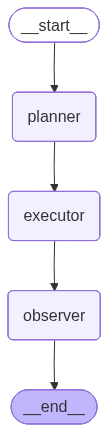
The planner discovers a plan, the executor runs each action, and the observer checks progress — replanning automatically if something fails.
from IPython.display import Image, display

graph = GoapGraph(actions=actions)
display(Image(graph.compile().get_graph().draw_mermaid_png()))
2. Run the A* → CSP pipeline#
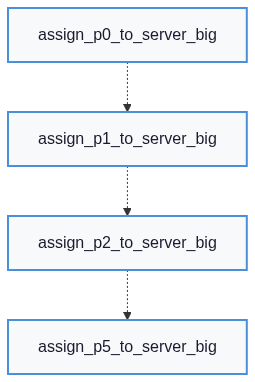
langgoap.planner.pipeline.plan() runs A* first, then routes the
result through the CSP validator. The returned Plan carries
metadata.csp with status, resource usage breakdown, and
constraint evaluations.
plan_obj = pipeline_plan(
    cloud_balancing_start(),
    cloud_balancing_goal(),
    actions,
)

print(f"CSP status: {plan_obj.metadata.csp.status.value}")
print(f"Plan:")
for step in plan_obj.actions:
    print(f"  {step.name}")
display(Image(plan_obj.draw_mermaid_png()))
3. Resource usage breakdown#
CSPMetadata.resource_usage reports the aggregate total for every
resource key touched by the plan. Because the A* search landed on
a server_big-heavy assignment and server_big has abundant
capacity, every hard constraint is satisfied and the primary plan
is returned as-is. No alternative enumeration runs.
usage = {u.key: u.total for u in plan_obj.metadata.csp.resource_usage}

print("Per-server utilization (usage / capacity):")
for s in SERVERS:
    cpu = usage.get(f'cpu_{s.name}', 0)
    mem = usage.get(f'mem_{s.name}', 0)
    net = usage.get(f'net_{s.name}', 0)
    print(f"  {s.name:14s} cpu={cpu:3.0f}/{s.cpu:<3d} mem={mem:3.0f}/{s.memory:<3d} net={net:3.0f}/{s.network:<3d}")

print(f"\nTotal cost: ${usage.get('cost_usd', 0):.2f}")
Per-server utilization (usage / capacity):
  server_big     cpu=  6/24  mem=  9/96  net= 10/16
  server_small   cpu=  0/6   mem=  0/4   net=  0/6

Total cost: $1920.00
4. Forced placement via hard constraints#
Process p1 requires 6 memory units — more than server_small
provides (4). Any plan that places p1 on server_small would
violate the mem_server_small ≤ 4 constraint. The CSP validator
will reject such a plan, and the pipeline will enumerate
alternatives to find a legal assignment for p1.
Let’s force the issue: start with every process except p1
pre-assigned to server_small so A* only has to place p1.
start = cloud_balancing_start()
# Pretend p0, p2, p5 are already running on server_small — valid because
# their combined cpu=3, mem=3, net=9 (note: net=9 would overflow server_small's
# net=6, but we won't re-validate the starting state here — we're only
# demonstrating that the planner picks server_big for p1 in isolation).
start_p1_only = dict(start)
start_p1_only["assigned_p0"] = True
start_p1_only["assigned_p2"] = True
start_p1_only["assigned_p5"] = True

plan_p1 = pipeline_plan(
    start_p1_only,
    cloud_balancing_goal(),
    actions,
)

assert plan_p1 is not None
p1_step = next(a for a in plan_p1.actions if "_p1_" in a.name)
print(f"p1 was placed on: {p1_step.name.rsplit('_to_', 1)[1]}")
print(f"(server_small mem=4 < p1.mem=6 → the only feasible computer is server_big)")
5. Infeasibility: a cost budget that can’t be met#
The cheapest possible assignment (p1 on server_big, rest on
server_small) still costs 480 + 66 * 3 = 678. Adding a hard
cost_usd ≤ 100 constraint makes every candidate plan infeasible.
The CSP is advisory — the plan still executes, but the status is
clearly recorded on plan.metadata.csp.
from langgoap import ConstraintSpec, GoalSpec
from langgoap.goals import ObjectiveDirection

tight_goal = GoalSpec(
    conditions={f"assigned_{p.name}": True for p in PROCESSES},
    constraints=(
        ConstraintSpec(key="cost_usd", max=100.0, level="hard"),
    ),
    objectives={"cost_usd": ObjectiveDirection.MINIMIZE},
)

tight_plan = pipeline_plan(
    cloud_balancing_start(),
    tight_goal,
    actions,
)

cost_usd = next(u.total for u in tight_plan.metadata.csp.resource_usage if u.key == 'cost_usd')
print(f"Budget:       $100.00")
print(f"Plan cost:    ${cost_usd:.2f}")
print(f"CSP status:   {tight_plan.metadata.csp.status.value}")
6. End-to-end via GoapGraph#
For production deployments, you’d wire this up via GoapGraph
and let LangGraph run the full plan → execute → observe loop.
The executor applies the effects of each assignment in order,
and the observer checks the goal conditions after every step.
result = GoapGraph(actions=actions).invoke(
    goal=cloud_balancing_goal(),
    world_state=cloud_balancing_start(),
)

print(f"Status:   {result['status']}")
assigned = sorted(k for k, v in result['world_state'].items() if v is True)
print(f"Assigned: {assigned}")
Status:   goal_achieved
Assigned: ['assigned_p0', 'assigned_p1', 'assigned_p2', 'assigned_p5']
Summary#
One problem instance, one LangGOAP action catalog. Each
(process, computer)pair is a distinctActionSpec; resources and constraints handle the bin-packing rules.A proposes, CSP disposes.* A* finds a plan fast; CSP validates capacity, enumerates alternatives on infeasibility, and picks the cheapest feasible option via CP-SAT.
Forced placements come for free. Hard constraints catch illegal assignments (like
p1onserver_small) without custom logic.CSP is advisory, not blocking. Infeasible plans still execute; status and resource breakdown are reported via
plan.metadata.cspfor callers to inspect.
Every scenario here is verified by
tests/integration/test_cloud_balancing.py.