

Text-to-SQL Agent — deepagents’ workflow as GOAP#
A Tier 2 tutorial that GOAPifies the
text-to-sql-agent example
from deepagents. The original agent threads a single LLM through
schema exploration, query drafting, execution, and refinement via
prompt engineering. LangGOAP does the same thing with an
explicit GOAP plan where each phase is an ActionSpec with real
preconditions and effects.
This tutorial spotlights three planning features at once:
Action sequencing —
explore_schemamust fire before any draft action because every draft preconditions onschema_known=True.Replanning on execution failure — a cheap
fast_query_attemptdrafts a SQL string with a deliberate typo. Running it raisessqlite3.OperationalError, so the executor blacklists the action and the planner falls back on the more expensivecareful_query_attempt.effect_validatoras a soundness check — the fallback action attaches a validator that verifies the query produced at least one row, demonstrating how postcondition checks complement preconditions and declared effects.
The tutorial uses sqlite3 with an in-memory connection seeded
from a compact Chinook subset (Customer + Invoice) so nothing
is written to disk and the “top spenders” answer is
deterministic.
import langgoap

# The fast-query-attempt action deliberately raises so the executor
# blacklists it and the planner can replan; silence the expected
# warning so the notebook output stays clean.
langgoap.set_log_level("ERROR")

from langgoap import GoapGraph
from tutorial_examples.data.sql_query_instance import (
    CUSTOMER_ROWS,
    EXPECTED_TOP_SPENDERS,
    INVOICE_ROWS,
)
from tutorial_examples.sql_query_agent import (
    CAREFUL_QUERY_SQL,
    FAST_QUERY_SQL,
    build_in_memory_db,
    sql_query_agent_actions,
    sql_query_agent_goal,
    sql_query_agent_start,
)

print(f'Customers seeded: {len(CUSTOMER_ROWS)}')
for cid, first, last, country in CUSTOMER_ROWS:
    total_invoices = sum(1 for r in INVOICE_ROWS if r[1] == cid)
    total_spend = sum(r[2] for r in INVOICE_ROWS if r[1] == cid)
    print(f'  {cid}  {first} {last:<15s} ({country:<14s})  invoices={total_invoices}  spent={total_spend:.2f}')
1. The question and the expected answer#
The user wants the three customers who have spent the most. Because the data is hand-picked the answer is deterministic:
for rank, (name, spent) in enumerate(EXPECTED_TOP_SPENDERS, start=1):
    print(f'  #{rank}  {name:<22s}  {spent:6.2f}')
  #1  Helena Holý              49.62
  #2  Richard Cunningham       47.62
  #3  Luís Gonçalves           39.62
2. The action catalog#
Three actions model the classic text-to-SQL workflow:
Action |
Precondition |
Effect |
Cost |
Notes |
|---|---|---|---|---|
|
|
|
1 |
Introspects |
|
|
|
1 |
Drafts a query with a misspelled column — raises |
|
|
|
3 |
Correct draft + |
The cost delta is the whole story: A* prefers the cheap
(explore_schema → fast_query_attempt, total cost 2) path and
only falls back on the careful draft after the fast one fails at
runtime.
conn = build_in_memory_db()
actions = sql_query_agent_actions(conn)
for a in actions:
    validator = 'yes' if a.effect_validator is not None else 'no'
    print(f'  {a.name:<24s}  pre={dict(a.preconditions)}  eff={dict(a.effects)}  cost={a.cost}  validator={validator}')
  explore_schema            pre={'schema_known': False}  eff={'schema_known': True}  cost=1.0  validator=no
  fast_query_attempt        pre={'schema_known': True, 'answer_ready': False}  eff={'answer_ready': True}  cost=1.0  validator=no
  careful_query_attempt     pre={'schema_known': True, 'answer_ready': False}  eff={'answer_ready': True}  cost=3.0  validator=yes
GOAP Execution Graph#
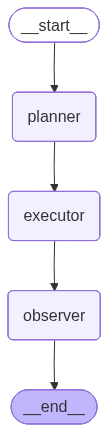
The planner discovers a plan, the executor runs each action, and the observer checks progress — replanning automatically if something fails.
from IPython.display import Image, display

graph = GoapGraph(actions=actions)
display(Image(graph.compile().get_graph().draw_mermaid_png()))
3. Plan the cheap path#
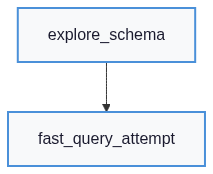
A* doesn’t know the fast query is broken — cost is all it
sees. The initial plan is explore_schema → fast_query_attempt
at total cost 2.
from langgoap.planner.astar import plan as astar_plan
from langgoap.state import PlanningState

initial_plan = astar_plan(
    PlanningState.from_dict(sql_query_agent_start()),
    sql_query_agent_goal(),
    actions,
)
print('Initial plan:')
for step, a in enumerate(initial_plan.actions, start=1):
    print(f'  {step}. {a.name}  (cost {a.cost})')
print(f'Total cost: {initial_plan.total_cost}')
Initial plan:
  1. explore_schema  (cost 1.0)
  2. fast_query_attempt  (cost 1.0)
Total cost: 2.0
display(Image(initial_plan.draw_mermaid_png()))
4. Peek at the drafted SQL strings#
fast_query_attempt uses a column that doesn’t exist —
c.Frst_Name. sqlite will reject it the moment the executor
calls conn.execute(...):
print('FAST (broken):')
print(FAST_QUERY_SQL)
print()
print('CAREFUL (correct):')
print(CAREFUL_QUERY_SQL)
FAST (broken):
SELECT c.Frst_Name, SUM(i.Total) AS Spent
FROM Customer c JOIN Invoice i ON c.CustomerId = i.CustomerId
GROUP BY c.CustomerId
ORDER BY Spent DESC
LIMIT 3

CAREFUL (correct):
SELECT c.FirstName || ' ' || c.LastName AS Name,
       ROUND(SUM(i.Total), 2) AS Spent
FROM Customer c JOIN Invoice i ON c.CustomerId = i.CustomerId
GROUP BY c.CustomerId
ORDER BY Spent DESC
LIMIT 3
5. Run the full GOAP loop#
Running the plan exercises the whole loop — executor, observer, blacklist, replanner — on the sqlite connection we just built.
graph = GoapGraph(actions=actions)
result = graph.invoke(
    goal=sql_query_agent_goal(),
    world_state=sql_query_agent_start(),
)

print(f'Status      : {result["status"]}')
print(f'Replans     : {result.get("replan_count", 0)}')
print(f'Blacklisted : {list(result.get("blacklisted_actions", []))}')
print()
print('Execution history:')
for h in result['execution_history']:
    status = 'OK' if h.success else f'FAIL ({h.error})'
    print(f'  {h.action_name:<24s}  {status}')
Status      : goal_achieved
Replans     : 1
Blacklisted : ['fast_query_attempt']

Execution history:
  explore_schema            OK
  fast_query_attempt        FAIL (no such column: c.Frst_Name)
  careful_query_attempt     OK
6. The answer the agent actually returned#
On success the executor stores the drafted SQL and its result set
into world state under sql and results. The observer checks
answer_ready=True and routes to the terminal node.
print(f'SQL used    :\n{result["world_state"]["sql"]}')
print()
print('Top spenders:')
for rank, (name, spent) in enumerate(result['world_state']['results'], start=1):
    print(f'  #{rank}  {name:<22s}  {spent:6.2f}')
SQL used    :
SELECT c.FirstName || ' ' || c.LastName AS Name,
       ROUND(SUM(i.Total), 2) AS Spent
FROM Customer c JOIN Invoice i ON c.CustomerId = i.CustomerId
GROUP BY c.CustomerId
ORDER BY Spent DESC
LIMIT 3

Top spenders:
  #1  Helena Holý              49.62
  #2  Richard Cunningham       47.62
  #3  Luís Gonçalves           39.62
7. The effect_validator soundness check#
careful_query_attempt ships with a validator that rejects
empty result sets. Running the same action against an unseeded
database exercises the failure branch — the executor marks the
action failed and replanning takes over. We drive the validator
directly here so the pattern is visible without depending on the
internal action-failed machinery:
empty_conn = build_in_memory_db(seed=False)
empty_actions = {a.name: a for a in sql_query_agent_actions(empty_conn)}
careful = empty_actions['careful_query_attempt']

raw = careful.execute({'schema_known': True, 'answer_ready': False})
print(f'Query returned    : {raw["results"]}')
print(f'Validator verdict : {careful.validate_effects({}, raw)}')
Query returned    : []
Validator verdict : False
False from the validator tells the executor the action did not
actually accomplish what it claimed, triggering the same
blacklist + replan dance that fast_query_attempt used in the
happy-path run above.
8. Natural-language intake#
As with the other Tier 2 tutorials, LangGOAP can take a plain
English request and turn it into a GoalSpec via
GoalInterpreter. For a runnable notebook we use
FakeStructuredModel so there is no API key dependency — swap in
ChatOpenAI, ChatAnthropic, or any BaseChatModel subclass in
production.
from langgoap import GoalInterpreter, InterpretedGoal
from langgoap.testing import FakeStructuredModel

llm = FakeStructuredModel(
    response=InterpretedGoal(
        conditions={'answer_ready': True},
        constraints=[],
        objectives=[],
        reasoning='The user wants a concrete answer, so answer_ready must be True.',
    )
)

nl_actions = sql_query_agent_actions(build_in_memory_db())
nl_result = GoapGraph(actions=nl_actions).invoke_nl(
    'Show me the three customers who have spent the most.',
    llm=llm,
    world_state=sql_query_agent_start(),
)

print(f'Status : {nl_result["status"]}')
for rank, (name, spent) in enumerate(nl_result['world_state']['results'], start=1):
    print(f'  #{rank}  {name:<22s}  {spent:6.2f}')
Status : goal_achieved
  #1  Helena Holý              49.62
  #2  Richard Cunningham       47.62
  #3  Luís Gonçalves           39.62
Summary#
Three actions, one deliberate typo, and an sqlite connection are enough to demonstrate the core LangGOAP recovery story:
Sequencing falls out of preconditions — the draft actions simply cannot fire until
explore_schemasetsschema_known.Blacklisting turns a one-off exception into a planning signal without the user having to catch anything.
effect_validatoracts as a belt-and-braces soundness check for actions whose success can only be verified after the fact — “the query ran” is not the same as “the query was meaningful”.
The integration test that pins this tutorial lives at
tests/integration/test_sql_query_agent.py.