

Deep Research Agent — create_goap_agent + tracing + history in Store#
A Tier 3 tutorial that GOAPifies the
deep_research example
from LangChain’s deepagents. The original runs an orchestrator loop
that calls write_todos, delegates to a research sub-agent that calls
Tavily, then writes the final report to a mock filesystem. Here we
translate the same five-step workflow into a LangGOAP plan driven by
the Layer A one-liner create_goap_agent, with a hermetic in-memory
corpus standing in for Tavily so the notebook runs without network
access or API keys.
This notebook spotlights five LangGOAP features at once:
create_goap_agent— the “most prebuilt” Layer A on-ramp. Wrap ordinary@toolfunctions, pass explicit preconditions/effects, and get back a compiled LangGraph graph with zero manualActionSpecplumbing.PlanningTracerobservability — aLoggingTracercaptures every plan/replan/goal-achieved event so you can see the whole orchestrator loop in human-readable form.StoreExecutionHistorypersistence — a LangGraphInMemoryStorerecords every successful run as anExecutionRecord; diagnostics can query the history by goal hash across multiple invocations.Multi-step replanning — the cheap
search_broad_corpustool raisesRateLimitErroragainst a rate-limited workspace. The executor blacklists it and the planner’s fallback re-routes through the more expensivesearch_deep_corpuson the next pass.Natural-language intake —
GoapGraph.invoke_nldrives the same end-to-end run from a plain English research question.
Everything is hermetic: no shell commands, no real web traffic, no
external dependencies. The whole tutorial is exercised by
tests/integration/test_deep_research_agent.py and this notebook
imports the exact same helpers the test imports, so what you see
below is identical to what CI verifies on every commit.
import logging

import langgoap

# search_broad_corpus deliberately raises on the first pass so the
# planner can replan; silence the expected warning so the notebook
# output stays readable.
langgoap.set_log_level("ERROR")

from tutorial_examples.data.deep_research_instance import (
    CORPUS,
    EXPECTED_BROAD_FINDING_IDS,
    EXPECTED_DEEP_FINDING_IDS,
    EXPECTED_TOPICS,
    MIN_REPORT_CITATIONS,
    RESEARCH_REQUEST,
)
from tutorial_examples.deep_research_agent import (
    ResearchWorkspace,
    deep_research_costs,
    deep_research_effects,
    deep_research_goal,
    deep_research_preconditions,
    deep_research_start,
    deep_research_tools,
)

print(f'Corpus size       : {len(CORPUS)} documents')
print(f'Research request  : {RESEARCH_REQUEST}')
print(f'Minimum citations : {MIN_REPORT_CITATIONS}')
1. The corpus and the expected decomposition#
CORPUS is a ten-document slice of AI/ML papers, each tagged with a
small topic set. The decomposition step scans the request against the
corpus’s tag vocabulary and records each matching tag in corpus order
— a deterministic substitute for the LLM-driven write_todos step
in the deepagents original.
for doc in CORPUS:
    tags = ','.join(doc.tags)
    print(f'  {doc.id:<7s}  {doc.title[:44]:<44s}  [{tags}]')

print()
print(f'Expected topics from decomposition: {list(EXPECTED_TOPICS)}')
  doc_1    Attention Is All You Need                     [transformers,attention,deep_learning]
  doc_2    The Illustrated Transformer                   [transformers,attention,education]
  doc_3    Retrieval-Augmented Generation for Knowledge  [retrieval_augmented_generation,knowledge_base,nlp]
  doc_4    Dense Passage Retrieval for Open-Domain QA    [retrieval_augmented_generation,dense_retrieval,nlp]
  doc_5    ReAct: Synergizing Reasoning and Acting in L  [agent_frameworks,reasoning,tool_use]
  doc_6    LangGraph: Stateful, Multi-Actor LLM Applica  [agent_frameworks,orchestration,langchain]
  doc_7    Toolformer: Language Models Can Teach Themse  [agent_frameworks,tool_use,self_supervision]
  doc_8    Goal-Oriented Action Planning for Games       [goap,planning,game_ai]
  doc_9    Reinforcement Learning from Human Feedback    [alignment,rlhf,instruction_tuning]
  doc_10   Constitutional AI: Harmlessness from AI Feed  [alignment,self_critique,rlhf]

Expected topics from decomposition: ['transformers', 'retrieval_augmented_generation', 'agent_frameworks']
2. The tools, preconditions, effects, and costs#
Five tools model the orchestrator loop:
tool |
analogue in |
cost |
|---|---|---|
|
|
1 |
|
|
1 |
|
cheap |
2 |
|
exhaustive |
5 |
|
|
1 |
Every tool is an ordinary LangChain @tool function that closes over
a shared ResearchWorkspace object. The workspace holds the real
corpus, the gathered findings, and the final report; GOAP only tracks
the four boolean phase flags that drive planning
(request_saved, topics_planned, findings_gathered,
report_written). That clean separation lets Layer A’s generic
goapify_tool wrapper stay completely content-agnostic.
Why every tool declares a query: str parameter. Layer B’s
goapify_tool wrapper binds tool arguments from the current
world-state dict by name: for every field in a tool’s
args_schema it reads the matching key from state['world_state']
and forwards the value. The research request sits on that world
state under the key 'query', so each of the five tools declares
query: str to receive it — even decompose_topics,
search_broad_corpus, search_deep_corpus, and synthesize_report,
which ignore the value and read the previously-saved request off the
workspace instead. You will see a del query on the first line of
those four tools in deep_research_agent.py; that is an
intentional acknowledgement of the binding constraint, not dead
code. The upside is that Layer A never has to parse docstrings or
guess at argument bindings to wire a tool into the planner.
workspace = ResearchWorkspace(rate_limit_active=False)
tools = deep_research_tools(workspace)

pre = deep_research_preconditions()
eff = deep_research_effects()
costs = deep_research_costs()
for t in tools:
    p = pre.get(t.name, {})
    e = eff.get(t.name, {})
    c = costs.get(t.name, 1.0)
    print(f'  {t.name:<24s}  cost={c}  pre={p}  eff={e}')
  save_research_request     cost=1.0  pre={'request_saved': False}  eff={'request_saved': True}
  decompose_topics          cost=1.0  pre={'request_saved': True, 'topics_planned': False}  eff={'topics_planned': True}
  search_broad_corpus       cost=2.0  pre={'topics_planned': True, 'findings_gathered': False}  eff={'findings_gathered': True}
  search_deep_corpus        cost=5.0  pre={'topics_planned': True, 'findings_gathered': False}  eff={'findings_gathered': True}
  synthesize_report         cost=1.0  pre={'findings_gathered': True, 'report_written': False}  eff={'report_written': True}
GOAP Execution Graph#
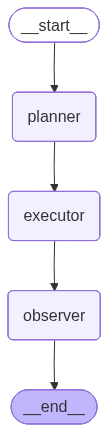
The planner discovers a plan, the executor runs each action, and the observer checks progress — replanning automatically if something fails.
from IPython.display import Image, display
from langgoap import GoapGraph
from langgoap.integrations import goapify_tool

graph_actions = [
    goapify_tool(
        t,
        preconditions=pre.get(t.name),
        effects=eff.get(t.name),
        cost=costs.get(t.name, 1.0),
    )
    for t in tools
]
display(Image(GoapGraph(actions=graph_actions).compile().get_graph().draw_mermaid_png()))
3. The Layer A one-liner: create_goap_agent#
create_goap_agent accepts the list of tools, a GoalSpec, and the
maps of preconditions/effects/costs. It wraps each tool via Layer B’s
goapify_tool and returns a CompiledStateGraph ready for
.invoke() — no manual ActionSpec construction, no explicit
GoapGraph builder. The shape is deliberately the same as
langgraph.prebuilt.create_react_agent so LangGraph users feel at
home immediately.
The happy path below uses rate_limit_active=False, so the cheap
search_broad_corpus path fires end-to-end:
from langgoap import create_goap_agent, successful_action_names

agent = create_goap_agent(
    tools=tools,
    goal=deep_research_goal(),
    preconditions=pre,
    effects=eff,
    costs=costs,
)

result = agent.invoke({
    'goal': deep_research_goal(),
    'world_state': deep_research_start(),
})

print(f'Status       : {result["status"]}')
print(f'Replans      : {result["replan_count"]}')
print(f'Blacklisted  : {result.get("blacklisted_actions", [])}')
success_names = successful_action_names(result)
print(f'Succeeded    : {success_names}')
display(Image(result["plan"].draw_mermaid_png()))
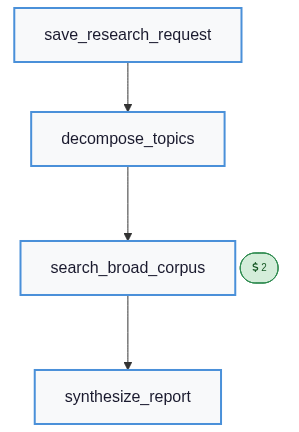
With the workspace wide open A* picks the cheapest chain
(save → decompose → broad → synthesize, total cost 5.0) and the
run completes in one planning pass. The workspace now holds the
gathered findings and the synthesized report:
print(f'Topics        : {workspace.topics}')
print(f'Findings      : {[f.id for f in workspace.findings]}')
print()
print('Report citations:')
for citation in workspace.report['citations']:
    print(f'  - {citation["title"][:60]:<60s}  {citation["url"]}')
Topics        : ['transformers', 'retrieval_augmented_generation', 'agent_frameworks']
Findings      : ['doc_1', 'doc_3', 'doc_5']

Report citations:
  - Attention Is All You Need                                     https://arxiv.org/abs/1706.03762
  - Retrieval-Augmented Generation for Knowledge-Intensive NLP    https://arxiv.org/abs/2005.11401
  - ReAct: Synergizing Reasoning and Acting in Language Models    https://arxiv.org/abs/2210.03629
4. Replanning after a rate-limit error#
Flip the workspace to rate_limit_active=True and the cheap broad
search raises RateLimitError on its first invocation. The executor
catches the exception, blacklists the action, and the planner’s
fallback route re-plans through the costlier search_deep_corpus
tool — exactly the blacklist + replan dance that Tier 2’s
vulnerability_scanner tutorial demonstrates, now wired end-to-end
through Layer A.
rate_limited_workspace = ResearchWorkspace(rate_limit_active=True)
rate_limited_agent = create_goap_agent(
    tools=deep_research_tools(rate_limited_workspace),
    goal=deep_research_goal(),
    preconditions=pre,
    effects=eff,
    costs=costs,
)

result = rate_limited_agent.invoke({
    'goal': deep_research_goal(),
    'world_state': deep_research_start(),
})

print(f'Status       : {result["status"]}')
print(f'Replans      : {result["replan_count"]}')
print(f'Blacklisted  : {result.get("blacklisted_actions", [])}')
print()
print('Execution history:')
for h in result['execution_history']:
    outcome = 'ok    ' if h.success else 'failed'
    err = f' ({h.error})' if h.error else ''
    print(f'  {outcome}  {h.action_name}{err}')
Status       : goal_achieved
Replans      : 1
Blacklisted  : ['search_broad_corpus']

Execution history:
  ok      save_research_request
  ok      decompose_topics
  failed  search_broad_corpus (rate limit exceeded on broad corpus search)
  ok      search_deep_corpus
  ok      synthesize_report
Two telltale signs confirm the replan happened:
search_broad_corpusappears in bothblacklisted_actionsand the execution history withsuccess=False.The final successful chain used
search_deep_corpusinstead, and the workspace now holds the deep-search findings (every document whose tag set intersects any topic).
print(f'Deep findings: {[f.id for f in rate_limited_workspace.findings]}')
assert tuple(f.id for f in rate_limited_workspace.findings) == EXPECTED_DEEP_FINDING_IDS
Deep findings: ['doc_1', 'doc_2', 'doc_3', 'doc_4', 'doc_5', 'doc_6', 'doc_7']
5. Observability — LoggingTracer#
A PlanningTracer is a tiny Protocol with one hook per planning
event: on_plan_start, on_plan_complete, on_action_start,
on_action_complete, on_replan, on_goal_achieved, plus their
async variants. LangGOAP ships NullTracer, LoggingTracer, and
MultiTracer; you pass one to GoapGraph(..., tracer=tracer) and
every event is routed through it.
LoggingTracer sends everything to the langgoap.tracing logger.
Below we capture that logger to a StringIO buffer so the notebook
can display what it would normally stream to stderr.
import io

from langgoap import GoapGraph, LoggingTracer
from langgoap.integrations import goapify_tool

# Route langgoap.tracing INFO logs to a StringIO buffer for display.
buffer = io.StringIO()
handler = logging.StreamHandler(buffer)
handler.setFormatter(logging.Formatter('%(message)s'))
tracing_logger = logging.getLogger('langgoap.tracing')
tracing_logger.addHandler(handler)
tracing_logger.setLevel(logging.INFO)

traced_workspace = ResearchWorkspace(rate_limit_active=True)
traced_actions = [
    goapify_tool(
        t,
        preconditions=pre.get(t.name),
        effects=eff.get(t.name),
        cost=costs.get(t.name, 1.0),
    )
    for t in deep_research_tools(traced_workspace)
]

traced_graph = GoapGraph(actions=traced_actions, tracer=LoggingTracer())
traced_result = traced_graph.invoke(
    goal=deep_research_goal(),
    world_state=deep_research_start(),
)
print(f'Status       : {traced_result["status"]}')
print()
print('Tracer log:')
for line in buffer.getvalue().splitlines():
    print(f'  {line[:100]}')

tracing_logger.removeHandler(handler)
Status       : goal_achieved

Tracer log:
  plan_start strategy=AStar goal=GoalSpec(conditions={'report_written': True})
  plan_complete duration_ms=0.09 plan=Plan(actions=['save_research_request', 'decompose_topics', 'sear
  action_start name=save_research_request
  action_complete result={'world_state': {'query': 'How do modern AI agent frameworks combine retrieva
  action_start name=decompose_topics
  action_complete result={'world_state': {'query': 'How do modern AI agent frameworks combine retrieva
  action_start name=search_broad_corpus
  action_complete result={'status': 'action_failed', 'execution_history': [ActionResult(action_name='s
  plan_start strategy=AStar goal=GoalSpec(conditions={'report_written': True})
  replan reason=action_failed new_plan=Plan(actions=['search_deep_corpus', 'synthesize_report'], total
  action_start name=search_deep_corpus
  action_complete result={'world_state': {'query': 'How do modern AI agent frameworks combine retrieva
  action_start name=synthesize_report
  action_complete result={'world_state': {'query': 'How do modern AI agent frameworks combine retrieva
  goal_achieved final_state={'query': 'How do modern AI agent frameworks combine retrieval-augmented g
6. Execution history in a LangGraph Store#
StoreExecutionHistory persists one ExecutionRecord per
successful/failed run into any LangGraph BaseStore. Under the
hood it maintains two reverse indexes (by goal hash, by failure
action) using only get/put — no search() calls, so every
BaseStore implementation works without configuring an embedder.
We drive three runs through a fresh InMemoryStore and then query
the history by the goal hash to see all three records:
from langgraph.store.memory import InMemoryStore

from langgoap import StoreExecutionHistory

store = InMemoryStore()
history = StoreExecutionHistory(store)

# Three independent runs — a mix of happy path and replanning.
for rate_limit in (False, True, False):
    ws = ResearchWorkspace(rate_limit_active=rate_limit)
    history_graph = GoapGraph(
        actions=[
            goapify_tool(
                t,
                preconditions=pre.get(t.name),
                effects=eff.get(t.name),
                cost=costs.get(t.name, 1.0),
            )
            for t in deep_research_tools(ws)
        ],
        history=history,
    )
    history_graph.invoke(
        goal=deep_research_goal(),
        world_state=deep_research_start(),
    )

# Query the store by goal hash using the public helper on
# StoreExecutionHistory — no private symbols required.
goal_hash = history.goal_hash_for(deep_research_goal())
records = history.query_by_goal(goal_hash)
print(f'Goal hash     : {goal_hash}')
print(f'Records found : {len(records)}')
print()
print('Recent runs (newest first):')
for rec in records:
    print(
        f'  {rec.timestamp.isoformat():<32s}  outcome={rec.outcome:<8s}  '
        f'replans={rec.replan_count}  plan={list(rec.plan_actions)}'
    )
Goal hash     : 0d629ccf03cec991
Records found : 3

Recent runs (newest first):
  2026-04-18T19:15:03.327482+00:00  outcome=success   replans=0  plan=['save_research_request', 'decompose_topics', 'search_broad_corpus', 'synthesize_report']
  2026-04-18T19:15:03.317390+00:00  outcome=success   replans=1  plan=['search_deep_corpus', 'synthesize_report']
  2026-04-18T19:15:03.306701+00:00  outcome=success   replans=0  plan=['save_research_request', 'decompose_topics', 'search_broad_corpus', 'synthesize_report']
The store now records three successful runs. A cost-learning system could query this history on every new invocation to bias A* against actions that historically failed — the data model for cost learning ships in v0.1.0 even though the learning algorithm itself is deliberately out of scope.
7. Natural-language goal intake#
As with every Tier 2/3 tutorial, LangGOAP can accept a plain English
research request and turn it into a GoalSpec via GoalInterpreter.
For a hermetic, runnable notebook we use FakeStructuredModel — the
public testing helper that mirrors the langchain.testing pattern —
so no real LLM is required.
from langgoap import InterpretedGoal
from langgoap.testing import FakeStructuredModel

nl_workspace = ResearchWorkspace(rate_limit_active=True)
nl_actions = [
    goapify_tool(
        t,
        preconditions=pre.get(t.name),
        effects=eff.get(t.name),
        cost=costs.get(t.name, 1.0),
    )
    for t in deep_research_tools(nl_workspace)
]
llm = FakeStructuredModel(
    response=InterpretedGoal(
        conditions={'report_written': True},
        constraints=[],
        objectives=[],
        reasoning='The operator asked for a written report.',
    ),
)
nl_result = GoapGraph(actions=nl_actions).invoke_nl(
    'Research how modern agent frameworks use RAG with transformers.',
    llm=llm,
    world_state=deep_research_start(),
)
print(f'Status       : {nl_result["status"]}')
print(f'Replans      : {nl_result["replan_count"]}')
print(f'Citations    : {len(nl_workspace.report["citations"])}')
Status       : goal_achieved
Replans      : 1
Citations    : 7
Summary#
Five tools, a hand-curated corpus, and a closed-over workspace are
enough to demonstrate the deepagents deep-research loop inside
LangGOAP — with full observability, persistence and NL intake at no
extra cost:
Layer A
create_goap_agentwraps ordinary@toolfunctions into a compiled LangGraph graph with zero manualActionSpecplumbing. Preconditions and effects are never LLM-inferred — they are passed explicitly so the planner has a sound abstraction.Replanning routes around the rate-limited cheap search without any special-case code: the executor catches the exception, the observer blacklists the failing action, and the planner’s fallback re-plans through the expensive
search_deep_corpus.LoggingTracerturns every plan/replan/goal-achieved event into a log line, and is drop-in compatible with OpenTelemetry or LangSmith adapters for production use.StoreExecutionHistorypersists run outcomes to any LangGraphBaseStoreusing onlyget/put, so you can query history by goal hash or failing action across multiple sessions.GoapGraph.invoke_nltakes a plain English request and drives the same end-to-end loop throughGoalInterpreter+ A* + the blacklist dance, hermetically testable viaFakeStructuredModel.
The integration test that pins every piece of behavior shown above
lives in tests/integration/test_deep_research_agent.py.