

Vulnerability Scanner — GOApy’s phased discovery as GOAP#
A Tier 2 tutorial that GOAPifies the
vuln_scanner example
from GOApy. The original walks nmap and nikto shell scripts through
discovery, port fingerprinting and vulnerability scanning. LangGOAP
does the same thing with an explicit GOAP plan where every phase is an
ActionSpec with real preconditions and effects, against an in-memory
simulated network so the notebook is hermetic.
This tutorial spotlights four planning features at once:
Phased sequencing —
discover_hosts → probe_ports → assess → generate_reportonly assembles in one order because each phase preconditions on the previous one’s effect flag.Sensor-driven world state — every scan action plays the role of a GOApy sensor: it observes the simulated network and writes the new facts back as effects so downstream actions can read them.
Replanning on a noisy probe — a cheap
probe_ports_aggressiveaction raisesBlockedByIDSErroragainst the simulated intrusion detection system. The executor blacklists it and replanning falls back on the more expensiveprobe_ports_stealth.effect_validatoras a soundness check —generate_reportships with a validator that rejects empty finding sets, illustrating how postcondition checks complement preconditions and declared effects.
Nothing in this notebook touches a real network. The SimulatedNetwork
fixture is the only source of truth for hosts, open ports and CVE
matches.
import logging

# The aggressive-probe action deliberately raises so the executor
# blacklists it and the planner can replan; silence the expected
# warning so the notebook output stays clean.
logging.getLogger('langgoap').setLevel(logging.ERROR)

from langgoap import GoapGraph
from tutorial_examples.data.vulnerability_scanner_instance import (
    CVE_CATALOG,
    EXPECTED_DISCOVERED_HOSTS,
    EXPECTED_FINDINGS,
    EXPECTED_SEVERITY_TOTALS,
    HOSTS,
)
from tutorial_examples.vulnerability_scanner import (
    SimulatedNetwork,
    vulnerability_scanner_actions,
    vulnerability_scanner_goal,
    vulnerability_scanner_start,
)

print(f'Hosts on simulated subnet: {len(HOSTS)}')
for host in HOSTS:
    state = 'up  ' if host.is_up else 'down'
    ports = ','.join(str(p) for p in host.open_ports) or '-'
    print(f'  {host.ip:<14s}  {host.hostname:<10s}  {state}  ports={ports}')
Hosts on simulated subnet: 5
  192.168.1.10    web01       up    ports=80,443
  192.168.1.20    db01        up    ports=5432
  192.168.1.30    files01     up    ports=22,445
  192.168.1.40    mail01      up    ports=25,587
  192.168.1.50    legacy01    down  ports=-
1. The CVE catalog and the expected report#
Three of the four reachable hosts run a service that has a known
vulnerability in our hand-curated catalog. The expected findings
list and per-severity totals are deterministic:
print('CVE catalog:')
for port, cve in sorted(CVE_CATALOG.items()):
    print(f'  port {port:<5d}  {cve.id:<16s}  {cve.severity:<8s}  {cve.service}')

print()
print('Expected findings:')
for host, cve, severity in EXPECTED_FINDINGS:
    print(f'  {host:<14s}  {cve:<16s}  {severity}')

print()
print(f'Severity totals : {EXPECTED_SEVERITY_TOTALS}')
CVE catalog:
  port 25     CVE-2024-39929    critical  Exim SMTP
  port 80     CVE-2023-44487    high      HTTP/2 Rapid Reset
  port 5432   CVE-2024-7348     high      PostgreSQL

Expected findings:
  192.168.1.10    CVE-2023-44487    high
  192.168.1.20    CVE-2024-7348     high
  192.168.1.40    CVE-2024-39929    critical

Severity totals : {'critical': 1, 'high': 2, 'medium': 0, 'low': 0}
2. The action catalog#
Five actions model the classic phased-discovery loop. Every action
plays the role of a GOApy sensor: in addition to flipping a boolean
effect flag, it writes back the data it observed (hosts,
host_ports, findings, report) so downstream actions can read
what previous phases discovered. Sensor side-effects do not appear
in ActionSpec.effects — those keys are only the planning predicates
A* reasons about — but they are merged into world state by the
executor when the action returns.
Action |
Precondition |
Effect (planning) |
Sensor side-effects (world state) |
Cost |
Notes |
|---|---|---|---|---|---|
|
|
|
|
1 |
Lists reachable hosts |
|
|
|
|
2 |
Fast SYN scan — blocked by IDS |
|
|
|
|
5 |
Slow stealth scan, always works |
|
|
|
|
3 |
CVE catalog lookup |
|
|
|
|
1 |
Aggregation + |
The cost delta between probe_ports_aggressive (2) and
probe_ports_stealth (5) is the whole story: A* prefers the cheap
aggressive path (total cost 7) and only falls back on the stealth
draft after the aggressive one fails at runtime.
network = SimulatedNetwork()
actions = vulnerability_scanner_actions(network)
for a in actions:
    validator = 'yes' if a.effect_validator is not None else 'no'
    print(f'  {a.name:<26s}  pre={dict(a.preconditions)}  eff={dict(a.effects)}  cost={a.cost}  validator={validator}')
  discover_hosts              pre={'hosts_discovered': False}  eff={'hosts_discovered': True}  cost=1.0  validator=no
  probe_ports_aggressive      pre={'hosts_discovered': True, 'ports_scanned': False}  eff={'ports_scanned': True}  cost=2.0  validator=no
  probe_ports_stealth         pre={'hosts_discovered': True, 'ports_scanned': False}  eff={'ports_scanned': True}  cost=5.0  validator=no
  assess_vulnerabilities      pre={'ports_scanned': True, 'vulns_assessed': False}  eff={'vulns_assessed': True}  cost=3.0  validator=no
  generate_report             pre={'vulns_assessed': True, 'report_generated': False}  eff={'report_generated': True}  cost=1.0  validator=yes
GOAP Execution Graph#
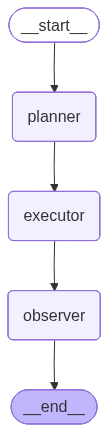
The planner discovers a plan, the executor runs each action, and the observer checks progress — replanning automatically if something fails.
from IPython.display import Image, display

graph = GoapGraph(actions=actions)
display(Image(graph.compile().get_graph().draw_mermaid_png()))
3. Plan the cheap path#
A* doesn’t know the aggressive scan will be blocked — cost is all it
sees. The initial plan is
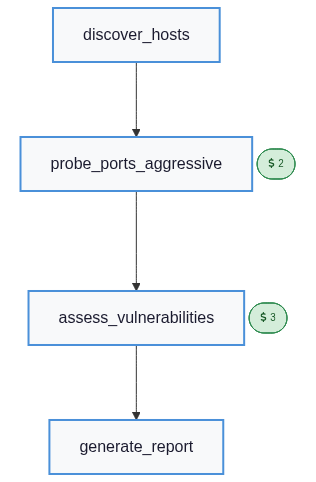
discover_hosts → probe_ports_aggressive → assess_vulnerabilities → generate_report at total cost 7.
from langgoap.planner.astar import plan as astar_plan
from langgoap.state import PlanningState

initial_plan = astar_plan(
    PlanningState.from_dict(vulnerability_scanner_start()),
    vulnerability_scanner_goal(),
    actions,
)
print('Initial plan:')
for step, a in enumerate(initial_plan.actions, start=1):
    print(f'  {step}. {a.name}  (cost {a.cost})')
print(f'Total cost: {initial_plan.total_cost}')
Initial plan:
  1. discover_hosts  (cost 1.0)
  2. probe_ports_aggressive  (cost 2.0)
  3. assess_vulnerabilities  (cost 3.0)
  4. generate_report  (cost 1.0)
Total cost: 7.0
display(Image(initial_plan.draw_mermaid_png()))
4. Run the full GOAP loop against the IDS-protected network#
Running the plan exercises the whole loop — executor, observer,
blacklist, replanner — against the simulated network we just built.
The aggressive probe raises BlockedByIDSError, the executor catches
the exception and adds the action to the blacklist, then the planner
rebuilds the plan around probe_ports_stealth.
graph = GoapGraph(actions=actions)
result = graph.invoke(
    goal=vulnerability_scanner_goal(),
    world_state=vulnerability_scanner_start(),
)

print(f'Status      : {result["status"]}')
print(f'Replans     : {result.get("replan_count", 0)}')
print(f'Blacklisted : {list(result.get("blacklisted_actions", []))}')
print()
print('Execution history:')
for h in result['execution_history']:
    status = 'OK' if h.success else f'FAIL ({h.error})'
    print(f'  {h.action_name:<26s}  {status}')
Status      : goal_achieved
Replans     : 1
Blacklisted : ['probe_ports_aggressive']

Execution history:
  discover_hosts              OK
  probe_ports_aggressive      FAIL (intrusion detection system blocked aggressive scan)
  probe_ports_stealth         OK
  assess_vulnerabilities      OK
  generate_report             OK
5. The report the agent actually returned#
On success the executor stores the discovered hosts, the per-host port
map and the aggregated vulnerability report in world state under
hosts, host_ports and report. The observer checks
report_generated=True and routes to the terminal node.
ws = result['world_state']
report = ws['report']

print(f'Hosts discovered : {ws["hosts"]}')
print(f'Scan method used : {ws["scan_method"]}')
print()
print(f'Findings ({len(report["findings"])}):')
for finding in report['findings']:
    print(
        f'  {finding["host"]:<14s}  port {finding["port"]:<5d}  '
        f'{finding["cve"]:<16s}  {finding["severity"]:<8s}  {finding["service"]}'
    )
print()
print(f'Severity totals  : {report["severity_totals"]}')
Hosts discovered : ['192.168.1.10', '192.168.1.20', '192.168.1.30', '192.168.1.40']
Scan method used : stealth

Findings (3):
  192.168.1.10    port 80     CVE-2023-44487    high      HTTP/2 Rapid Reset
  192.168.1.20    port 5432   CVE-2024-7348     high      PostgreSQL
  192.168.1.40    port 25     CVE-2024-39929    critical  Exim SMTP

Severity totals  : {'critical': 1, 'high': 2, 'medium': 0, 'low': 0}
6. The effect_validator soundness check#
generate_report ships with a validator that rejects empty finding
sets. Running the same action against an empty network exercises the
failure branch — the executor would mark the action failed and
replanning would take over. We drive the validator directly here so
the pattern is visible without depending on the internal
action-failed machinery:
empty_network = SimulatedNetwork(hosts=(), ids_active=False)
empty_actions = {a.name: a for a in vulnerability_scanner_actions(empty_network)}
report_action = empty_actions['generate_report']

ws = {
    'hosts_discovered': True,
    'ports_scanned': True,
    'vulns_assessed': True,
    'report_generated': False,
    'hosts': [],
    'host_ports': {},
    'findings': [],
}
raw = report_action.execute(ws)
post = {**ws, **raw}
# Pass the actual pre-state ws (not an empty dict) so the validator
# sees the same inputs the executor would feed it.
print(f'Findings returned : {raw["report"]["findings"]}')
print(f'Validator verdict : {report_action.validate_effects(ws, post)}')
Findings returned : []
Validator verdict : False
False from the validator tells the executor the action did not
actually accomplish what it claimed, triggering the same blacklist +
replan dance that probe_ports_aggressive used in the happy-path run
above.
7. Natural-language intake#
As with the other Tier 2 tutorials, LangGOAP can take a plain English
request and turn it into a GoalSpec via GoalInterpreter. For a
runnable notebook we use FakeStructuredModel so there is no API key
dependency — swap in ChatOpenAI, ChatAnthropic, or any
BaseChatModel subclass in production.
from langgoap import GoalInterpreter, InterpretedGoal
from langgoap.testing import FakeStructuredModel

llm = FakeStructuredModel(
    response=InterpretedGoal(
        conditions={'report_generated': True},
        constraints=[],
        objectives=[],
        reasoning='The operator wants a vulnerability report, so report_generated must be True.',
    )
)

nl_actions = vulnerability_scanner_actions(SimulatedNetwork())
nl_result = GoapGraph(actions=nl_actions).invoke_nl(
    'Scan the local network and tell me what vulnerabilities you find.',
    llm=llm,
    world_state=vulnerability_scanner_start(),
)

print(f'Status : {nl_result["status"]}')
print(f'Severity totals : {nl_result["world_state"]["report"]["severity_totals"]}')
for finding in nl_result['world_state']['report']['findings']:
    print(
        f'  {finding["host"]:<14s}  {finding["cve"]:<16s}  {finding["severity"]}'
    )
Status : goal_achieved
Severity totals : {'critical': 1, 'high': 2, 'medium': 0, 'low': 0}
  192.168.1.10    CVE-2023-44487    high
  192.168.1.20    CVE-2024-7348     high
  192.168.1.40    CVE-2024-39929    critical
Summary#
Five actions, one simulated IDS and a tiny CVE catalog are enough to demonstrate the GOApy phased-discovery story end-to-end inside LangGOAP:
Sequencing falls out of preconditions — no action can fire before the previous phase has set its effect flag, mirroring how GOApy’s
active_http_servers.shre-invokeslist_active_nodes.shwhen the prerequisite file is missing.Sensor-driven state lets each scan action announce what it saw (hosts, ports, findings) so downstream phases can consume it without any sidecar bookkeeping.
Blacklisting turns a one-off
BlockedByIDSErrorinto a planning signal without the user having to catch anything.effect_validatoracts as a belt-and-braces soundness check for actions whose success can only be verified after the fact — “the scan ran” is not the same as “the scan found something worth reporting”.
The integration test that pins this tutorial lives at
tests/integration/test_vulnerability_scanner.py.